The Neumarkt
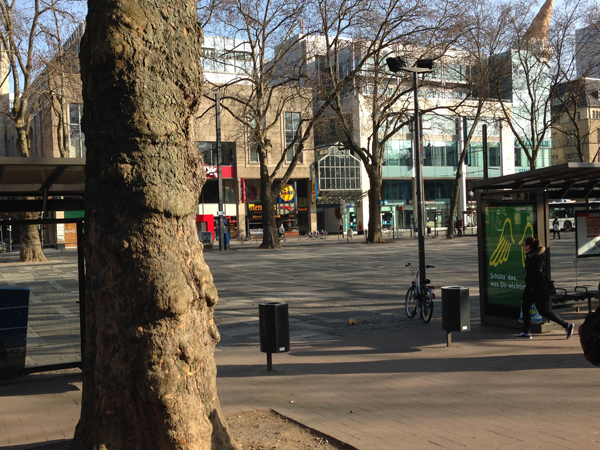
It is the largest of the 30 Cologne squares and it is located in the middle of Altstadt Süd. The Cologne Neumarkt ! It is 27,216 square meters and has a usable area of exactly 8,600 square meters. Incidentally, Neumarkt is called "Nümmat" in Kölsch.
About the story
Archbishop Hildolf established Neumarkt in 10 76 as a place in "novo mercato". This was documented in a certificate. So one wanted to relieve the old market in Cologne. Archbishop Hildolf even gave the cathedral monastery on Neumarkt 5 farmsteads. This area was certainly still uninhabited at that time. The area was located on the western city wall in Cologne. The definition as the new market center was at the same time a new way for the city planning. So far, all markets and their activities have been concentrated on two markets. This was on the one hand the Heumarkt and then also the Old Market. At that time the Neumarkt was mainly used as a sales point for cattle. There were also some festivals there. From 1178 the Neumarkt was called "novo Foro" or "novo mercato". In 1195 there was even a brewery there, which worked for the St. Aposteln Abbey.
Römer am Neumarkt
During construction work that became necessary due to an expansion of the Kreissparkasse Cologne, the remains of a Roman house were found on the property at Getrudenstrasse 14 to 16 at the end of the 1970s! Among other things, there were also beautiful wall paintings. It is believed that the house was a peristyle house. Some of these finds are now in the Roman-Germanic Museum and can be admired there. In 1881 the so-called " Athena head " was also found on Neumarkt. This is estimated in the time after Christ.
Further use of the Neumarkt
In 1197 the Count Florence of Hainaut organized tournaments on the Neumarkt. As already mentioned above, animals were primarily sold on this large marketplace. They were chickens or horses or other livestock. In 1374, a trough was therefore installed on the market square, among other things. Since horses were also sold on the market square, there was also a horse gate. There was also a water pump there and in 1392 even a windmill. This was about 18 meters high and up to 12 meters in diameter. In Cologne there were several windmills which stood in the country. Next to the mill on the Neumarkt there were also windmills at the Gereonstor or, for example, at the Ulrepforte. These windmills were of course especially used when the mills on the Rhine were out of order. Dark times were also experienced on the market square, however, as it was also used as a place of execution. A man was beheaded in the middle of downtown Cologne in 1382. It was the lay judge Gerhard von Benasis who was beheaded by an executioner. Heinrich von Stave was also killed on Neumarkt in 1396.
Lots of buildings
The first noteworthy building was a so-called predecessor of the Church of St. Apostles, which is still located there, in 965. More buildings were built in 1200. At the address Neumarkt number 2 / at the corner of Schildergasse, the so-called Schwerthof was also found in the same year. Some of the residents of the time even named themselves after their place of residence. For example, there was also a "Hermann vom Neumarkt" or a "Babette vom Neumarkt". A very rich Cologne merchant with the name "Diebold vom Neumarkt" is even immortalized in a Cologne street name. Because there is the so-called "Thieboldsgasse". Other well-known names or well-known houses are for example the "Haus Scharfenstein" or the patrician family Pfeil.
The Richmodis Saga
We want to spare you further house names or family names, we only allow ourselves to point out that a St. Agnes Hospital was found at Neumarkt. Family stories that we have already briefly mentioned above can be found under the addresses Neumarkt number 2 or number 4. However, we would like to briefly mention a story about Neumarkt number 6, because you can "still see" the story today, as there is still the so-called "Richmodis Tower" there. The married couple of Aducht and Richmodis belong to the well-known Cologne saga , namely the Richmodis saga.
This legend was about the wife Richmodis, who was afflicted by the "Black Death", the so-called plague. She was then buried particularly quickly in the churchyard of St. Apostles. And now comes the incredible part of the story! Because allegedly grave robbers tried to steal the jewelry from Mrs. Richmodis, which was given as grave goods of the dead. But when they released the dead woman, it turned out that Ms. Richmodis supposedly wasn't dead and got up again! Immediately she marched to her husband and knocked on the door. But the husband didn't open the door and just shouted through the door: "It's so much true that you are my wife, as my horses run from the stable up to the Söller."
However, this well-known saying suddenly became the truth and therefore the frightened husband actually had two horse heads affixed to the top floor of his own house as a reminder of this event. You can still admire these two horse heads today.
Other addresses
At the address Neumarkt 8 to 10 there was a farm with the name "zume Heydenriche". This courtyard was continuously expanded through the purchase of the neighboring property and expanded with magnificent halls and even its own house chapel. In its function, this courtyard even served as imperial accommodation and was therefore given the name "Palatium". It was a magnificent building, this large palace which was actually located directly on Neumarkt. Even emperors like Charles V and his brother Ferdinand I stayed here.
The Roman city wall
In the tenth century the "St. Apostles Immunity" was founded. In the 13th century the Dominican convent of St. Gertrud was built on the archbishop's estate. In the following years this chapel was replaced by a small church. In addition, a hospital was opened in 1308. The church of St. Gertrud stood on this spot for a long time until 1802. Today you can find the big one of the Kreissparkasse Köln there. The St. Aposteln building was continuously developed and is still located on Neumarkt today in the form of a beautiful basilica .
The numerous name changes
The Neumarkt has been renamed very often. Especially in the Middle Ages the name changed constantly:
- uff dem numarkt
- at the nuwen marte
- numarkt
- nuymarkt
- nui marckt
Late Middle Ages and Modern Times
The defense of the city of Cologne was important as it attracted many. For this reason, the gaffs were commissioned to defend the cathedral city in 1396. The crossbow or bow and arrow were used as weapons at that time. So that the gaffs could handle bows and arrows well, shooting competitions were held on the Neumarkt again and again. Target practice was particularly important and for this reason even plots were bought up in the 15th century and a so-called Schützenhof was built on Neumarkt. Participation and guard duty were important and therefore the citizens were obliged to do so.
The early days of Cologne
In 1740 there was a renewal of the famous square in the middle of the city. The council wanted to let the deserted Neumarkt appear in a new light and agreed to use it as a military parade ground. The mayor Johann Balthasar Joseph von Mühlheim even wanted to move the cattle markets to the well-known Heumarkt. In 1750 there were even plans for a guard room which should be located exactly on Neumarkt. As a further development, the Neumarkt was even activated as a place for the theater. In May 1768, the first play actually took place on Neumarkt in a wooden house. The "Deutsche Schaubühne" was the organizer and there were many interesting theater performances.
The French are coming
In 1794 the city of Cologne was occupied by the French. In this context, the Neumarkt was renamed once again and was now called "Place de la Republique". A freedom tree was even placed in the square. In the following years there was some back and forth which we don't want to explain here. An important indication, however, that Cologne has actually become a militarily important city. Thanks to its fortress structure, up to 500,000 soldiers could even be placed there in an emergency.
The Cologne Carnival
The well-known Cologne Rose Monday procession was organized in 1823 and carried out by the "Heroes Carneval". The cars always drove around Neumarkt. A well-known Cologne personality, namely Willi Ostermann, lived on Neumarkt. When he died in 1936, the funeral procession naturally led from Neumarkt in the direction of Aachener Strasse to the Melatenfriedhof.
The Prussian period in Cologne
The Neumarkt was even the venue for the Cologne Stock Exchange. Furthermore, the Neumarkt has also become a meeting point for art and culture. Because there is also the so-called "Haus Fastenrath". The art collector Johannes Fastenrath von Schreitterer and Below paintings. After he died in 1908, his house was bought in 1917. The Lempertz company did this in 1918 and this was the starting signal for the well-known Kunsthaus Lempertz.
The post-war period
After the Second World War, Cologne was in ruins. All roads leading to the Neumarkt were destroyed and the Neumarkt looked like a heap of rubble. It was then rebuilt and many famous buildings were erected. For example, the Schnütgen Museum in St. Cäcilien was reopened in 1956. Horticultural director Kurt Schönbohm took the opportunity and had a large fountain built on Neumarkt. Unfortunately, it was shut down in the 1990s. The horse heads from the Richmodis saga mentioned above were destroyed by the war. In 1958 the sculptor Wilhelm Müller Maus lovingly recreated the horses' heads. In February 1966, Schildergasse was completely converted into a pedestrian zone. And then in 1970 there was the first Christmas market in Cologne after the war.
Culture and art on Neumarkt
Many museums, educational institutions and galleries have settled around Neumarkt. We want to introduce these briefly. Among other things, the Käthe-Kollwitz-Museum is located on Neumarkt. Organized and this is organized by the Kreissparkasse Köln. You can see sculptures or hand drawings there. The entrance is in the Neumarkt Passage. The Lew Kopelew Forum can also be found there. It is to be seen as a meeting point for international understanding and is organized by the participation of the WDR and the Kreissparkasse Köln.
.gif)
.gif)
.gif)
.gif)
.gif)
.gif)
The so-called "Belgian House" is located very close to Neumarkt. The responsible architect is Johannes Schüller from Cologne. The Belgian consulate has been located there since the 1950s. In 2015 it was closed and the house was mostly empty. Under monument protection since 1990. For a long time the house had been put up for sale for 4,000,000 euros. It has been extensively renovated for a few months so we suspect that it was actually sold. Named after the Cologne art collector Josef Haubrich, the so-called "Josef-Haubrich-Hof Areal" can be found in the area around Fleischmengergasse and Leonard Tietz Straße. Again, it's about art and you can see some good works.
Shopping
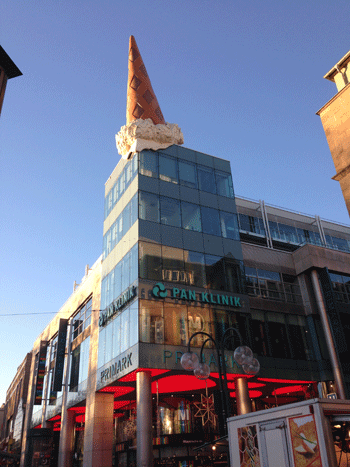
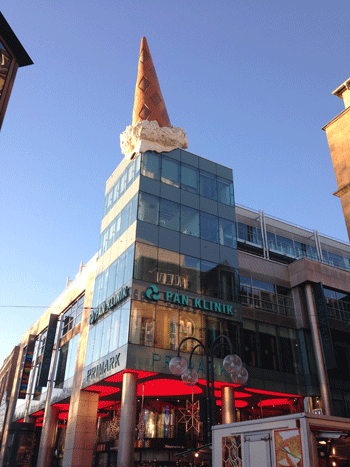
A very well-known place in Cologne is certainly the Neumarkt-Galerie. Because on the head of the gallery there is an incredibly great sculpture by the artist Claes Oldenburg. It is a huge upside down ice cream cone . The subsequent Neumarktpassage was opened in 1937 by the then Lord Mayor Robert Brandes. It is a very large commercial building with office and living space. The Neumarktgalerie has a huge 37,000 square meters of sales area. Among other things, there are shops there such as Primarkt.
Transport hub
As early as 1882, Cologne's Neumarkt was a so-called traffic junction . Because the first horse tram line ran from Aachener Straße, through the Hahnentor in the direction of Neumarkt. After the Cologne road network became more modern and Electrik found its way into the city in 1901, the first electric train ran across Neumarkt . Today the Neumarkt is the most important center in Cologne's transport network. All tram lines cross here both above and below ground. There are also several bus routes that run here.
The large market square is surrounded by the street of the same name called "Neumarkt". This is exactly 646 meters long.
The Roncalli Circus
The Roncalli Circus also likes to use this central location in Neumarkt again and again. Many performances in the circus tent have already been staged here.
Review and Outlook
As you can see, the Cologne Neumarkt has been the headquarters and an important place in Cologne both in the past and in the present. We therefore definitely recommend a visit.
Accommodation in downtown Cologne!
Do you want to walk to the cathedral? Do you want to walk to the fair? Then book our Apartment Cologne , then you can easily walk to Cologne Cathedral! Just cross the Rhine over the Deutzer Brücke and stroll through the old town. In about 14 minutes you have reached the cathedral! We look forward to your inquiry!